Inaugural Data Driven Defense Workshop
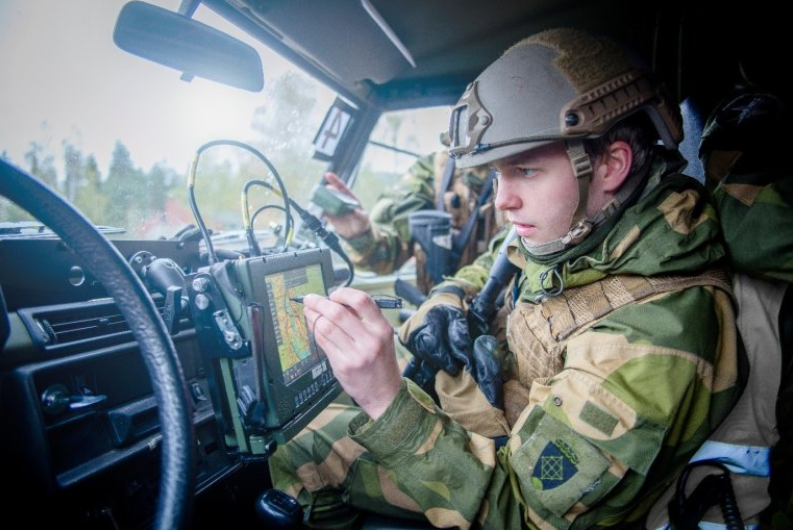
Participation in the first Data Driven Defense Workshop, organized by the Norwegian Defence University College, which examines how data, machine learning, and artificial intelligence are transforming military operations - spanning intelligence, targeting, autonomous systems, and cyber warfare, alongside the legal, ethical, and national-autonomy questions these raise.
The abstract "Simulation-Generated Data for Agentic Course of Action Development and World Models" was submitted by a team at FFI. It presents a decision-support architecture that grounds a multi-agent, multi-modal LLM planning pipeline - aligned with the Norwegian Army planning and decision-making process - inside a closed-loop constructive simulation, using a HybridRAG layer over doctrine and the operational knowledge graph, and the C2SIM/SWAP simulation to physically validate candidate courses of action. The resulting state-action-outcome trajectories are also intended to train a battlespace world model that can quickly screen candidate plans before committing them to high-fidelity simulation.
AQ²UASIM v2 - Simulators for Maritime Applications
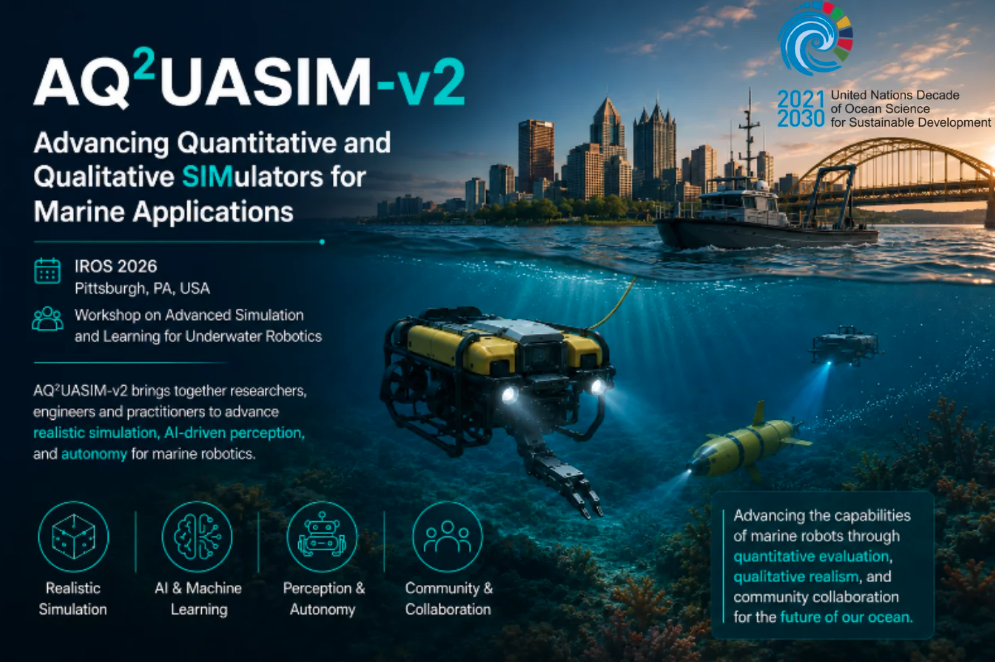
AQ²UASIM: Advancing Quantitative and QUAlitative SIMulators for marine applications v2 continues the push to lower the barriers to entry in underwater robotics by promoting realistic, open-source simulators for designing, testing, and optimizing control strategies, autonomy stacks, and software architectures. High-fidelity simulation is essential for marine robotics: it lets researchers stress-test algorithms against current, terrain, sensor noise, and actuator limits before risking hardware at sea.
This edition is officially endorsed as an activity of the United Nations Decade of Ocean Science for Sustainable Development and listed on the Ocean Decade events page. That recognition places the workshop inside a global effort to advance ocean science and sustainable technology - and reflects the community’s belief that better simulation is a prerequisite for safer, more capable, and more accessible marine robotics.
Organizing committee: Michele Grimaldi, Dr. Ignacio Carlucho, Dr. Markus Buchholz, Jungseok Hong, Dr. Mabel Zhang, Sebastian Realpe Rua, Dr. Fausto Ferreira, Sumer Tuncay, Carter Noh, Carlo Cernicchiaro, Tony Jacob, and Hayat Rajani. Steering committee: Dr. Maria Koskinopoulou, Dr. Nuno Gracias, and Prof. Yvan R. Petillot.
FFI Seminar - Distributed and Scalable Battle-Near ICT
I co-organized this FFI seminar on distributed and scalable battle-near ICT systems, which bring together command, coordination, and information infrastructure for dispersed military operations. I am leading the session "Planning Support with Artificial Intelligence and Simulation" together with Dr. Andreas Strand, where we explore how AI agents and simulation loops can assist operators in planning complex, time-critical missions.
The seminar targets defense-sector professionals involved in developing, procuring, operating, or maintaining tactical ICT systems, and connects ongoing research at FFI to operational needs in the field.
ICRA 2025 Workshop - Simulators for Maritime Applications
This inaugural workshop brought together researchers and engineers to explore simulation environments realistic enough to be invaluable for system design, risk assessment, and performance optimization in maritime and underwater robotics. It laid the groundwork for the second edition by identifying the simulators, benchmarks, and validation practices the community needs most.
Organizing committee: Michele Grimaldi, Dr. Ignacio Carlucho, Dr. Markus Buchholz, Dr. Mabel Zhang, Sebastian Realpe Rua, Dr. Fausto Ferreira, Sumer Tuncay, Carter Noh, Carlo Cernicchiaro, Tony Jacob, and Hayat Rajani. Steering committee: Dr. Maria Koskinopoulou, Dr. Nuno Gracias, and Prof. Yvan R. Petillot.
GazeboSim Maritime Meeting Community Talk: Motion Control for Tethered Multi-Robot Systems
I presented my Heriot-Watt UNITE research to the GazeboSim Maritime Meeting Community, covering autonomous underwater operations for multi-agent robots supporting offshore wind farm maintenance. The talk introduced a tethered AUV-ASV system - an underwater vehicle physically linked to a surface vehicle by a tether - built to inspect subsea wind-turbine foundations without sending crewed vessels offshore.
I showed how the system plans ahead of time - working out the shape the tether hangs in and keeping both robots within a safe path - and then how it adjusts on the fly to stay on course through waves, wind, and currents. I shared results from both simulation and real wave-tank tests with the physical AUV, ASV, and tether, along with the software setup behind it and some demo footage.
Marine Robotics (BlueRobotics)
Training for Seabyte
A training session I delivered at the National Robotarium for Seabyte, using the BlueRobotics ecosystem as a concrete example. It covered the concepts, sensors, vehicles, and open-source software stacks that underpin modern autonomous surface and underwater systems, giving the team a practical entry point into a complex field.
MotoROS2: Interface for ROS 2 Applications
MotoROS2 is the official ROS 2 driver for Yaskawa Motoman industrial robot controllers, replacing the earlier ROS 1-based MotoROS bridge with an interface built natively on ROS 2 middleware. It exposes standard ROS 2 action and topic interfaces for trajectory execution, joint state feedback, and I/O control, letting engineers run modern motion-planning stacks directly against production Yaskawa controllers without writing vendor-specific glue code.
At the ROS-Industrial Conference 2023 in Bordeaux, I gave a detailed presentation of this work, covering the driver architecture, the supported motion and I/O interfaces, and a set of reference applications built on top of it. I walked through how the interface can be configured and extended for different Yaskawa controller families, and discussed real deployment scenarios where custom applications can be arranged around the same core driver.